From AI Pilots to Production Momentum: What Turning the Flywheel Teaches About Transformation
July 2, 2026
The Real Bottleneck in Enterprise AI: Adoption, Not Awareness
July 2, 2026
Asir Selvasingh • June 1, 2026
Read time – 7 min
Agent frameworks matter. But enterprise AI builders need a production stack that makes intelligent apps and agents trusted, governed, observed, and owned after launch.
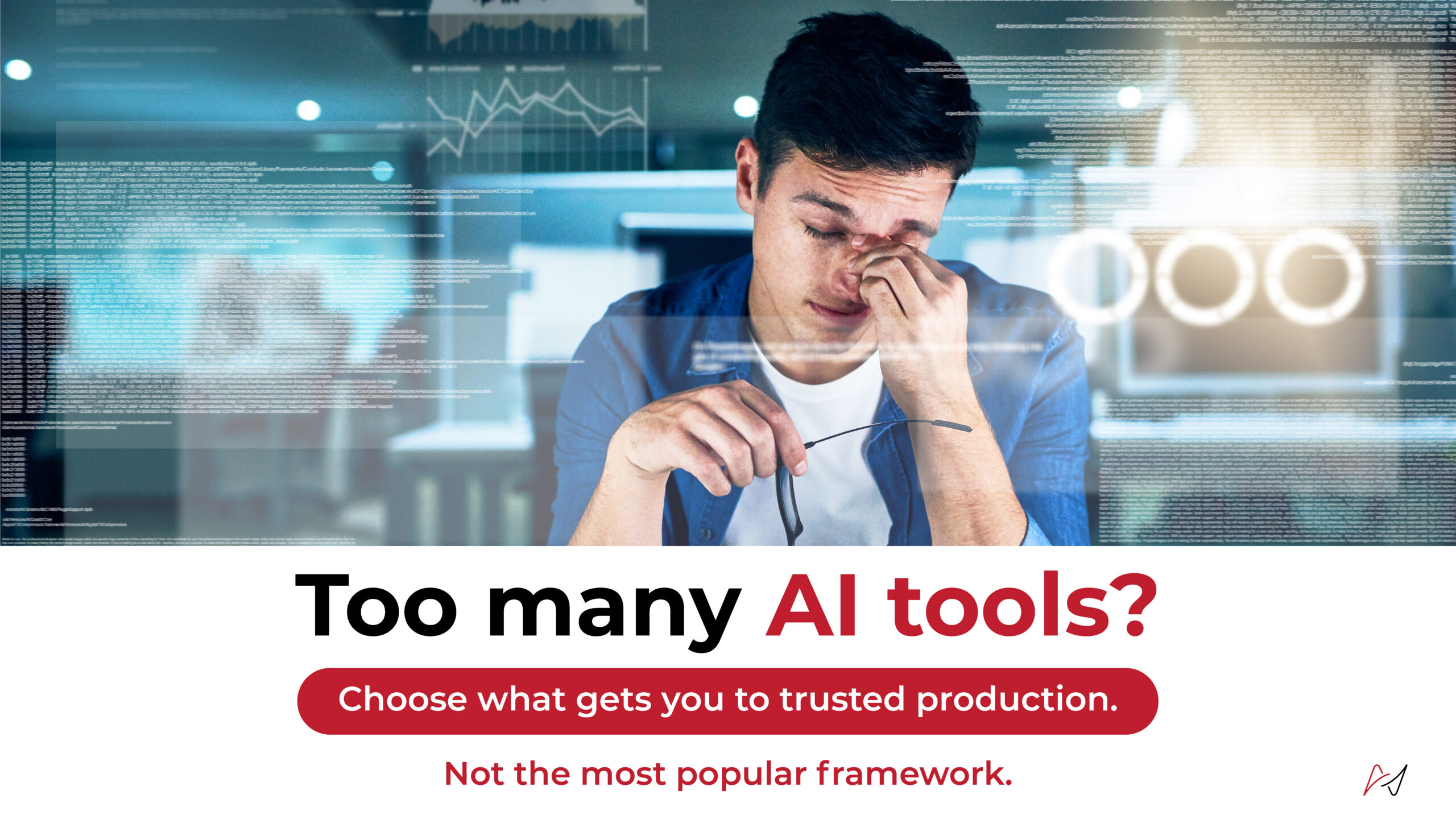
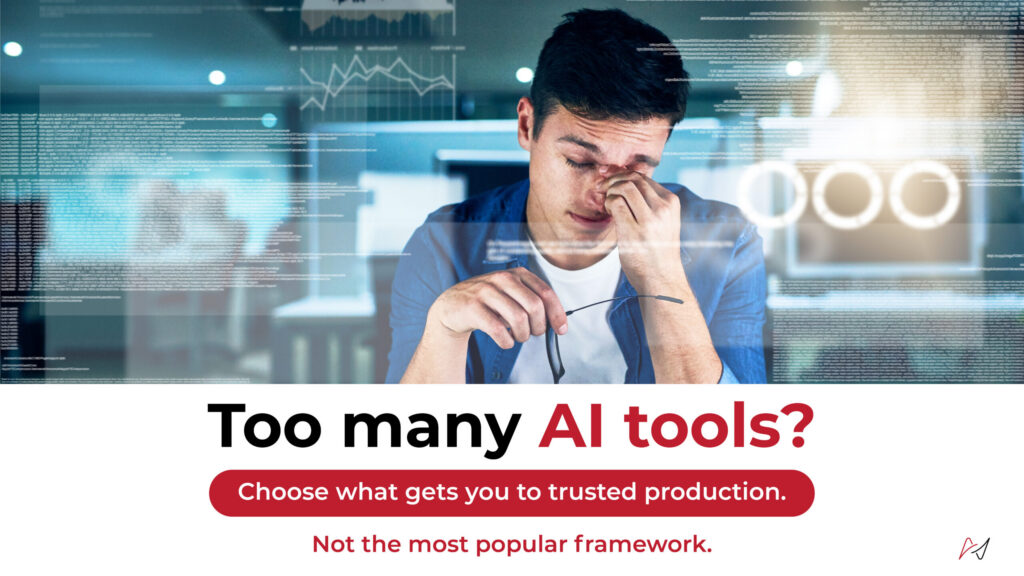
Figure 1: Too Many AI Tools
When the AI tool market feels crowded, do not chase the most popular framework. Choose what gets you to trusted production.
Too many AI tools? That is now a real enterprise problem. The issue is no longer a lack of options. The issue is choosing the right center of gravity.
Every week brings a new model, agent framework, cloud service, retrieval tool, observability layer, governance product, workflow platform, and AI infrastructure provider. For enterprise AI builders, that creates pressure.
Leaders want progress. Teams want clarity. Vendors keep moving. The business wants intelligent apps and agents that work. But production AI needs more than a tool decision. It needs trust, grounding, control, evaluation, observability, and ownership.
That is why the better question is not, “Which agent framework is most popular?” The better question is, “Which stack gets us to trusted production?”
The builders carrying the production burden
Enterprise AI builders are the heroes of this story. They include platform teams, app teams, data teams, security teams, product teams, enterprise architects, business technology leaders, and operations leaders.
They are not starting from a blank page. The business already wants intelligent apps and agents. The workflow opportunity is clear.
Now the builders face the next hard question: Which tools help us build AI that works safely, reliably, measurably, and at enterprise scale in production?
They are not trying to chase every new framework. They are not trying to win a framework debate. They are trying to turn AI into trusted business systems.
The tool market is crowded
The AI market is moving faster than most enterprises absorb. The choices span:
- Models
- Cloud platforms
- Agent frameworks
- Data grounding systems
- Vector and search tools
- Workflow platforms
- Evaluation tools
- Observability tools
- Governance tools
- AI infrastructure providers
That range of choice is useful. It also creates noise. The danger is not having options. The danger is choosing the most visible tool and treating that choice as the strategy.

Agent frameworks matter. They are building blocks, not the strategy.
A framework helps teams build agent workflows, manage state, call tools, and connect steps. But a framework does not make AI production-ready by itself. It does not solve enterprise identity, guarantee data permissions, prove quality, manage cost, create audit trails, define human approval, or own the system after launch.
The real risk is choosing the wrong center of gravity
A popular framework often feels like the fastest path forward. That is understandable. Frameworks give builders structure. They help teams move from a prompt to a workflow. They help agents call tools, route work, manage memory, and coordinate steps.
But if the framework becomes the center of gravity, the enterprise loses sight of the real production problem.
When teams rush to adopt the latest model or agent platform, they often skip the infrastructure work required for broad deployment. The instinct makes sense. Teams want to move fast, show progress, and avoid falling behind. But models and frameworks only create durable value when they sit on a foundation built for production, not only for the first launch.
As AI moves from models to copilots to more autonomous agents, the systems around AI must also mature. Enterprises need identity, data access, tool governance, evaluation, observability, and clear ownership. They also need interoperable frameworks and shared protocols so agents connect to enterprise tools and data in a secure, consistent way.
Trusted production needs more than orchestration. It needs identity, grounded data, governed tool use, evaluation before launch, observability after launch, human control where judgment matters, and a clear owner after launch.
The danger is choosing the most popular framework instead of the stack that gets the enterprise to trusted production.
The production stack becomes the guide
The guide is the Enterprise AI Production Stack. It is not a vendor directory. It is not a tool list. It is a production decision model.
It helps builders ask better questions:
- Which models fit the workload?
- Which enterprise data should ground the system?
- Which tools should agents use?
- Which actions need approval?
- How will quality be evaluated?
- How will behavior be observed?
- How will humans stay in control?
- Who owns the system after launch?
Production is the filter. Not popularity. Not hype. Not the newest framework. Not framework loyalty.
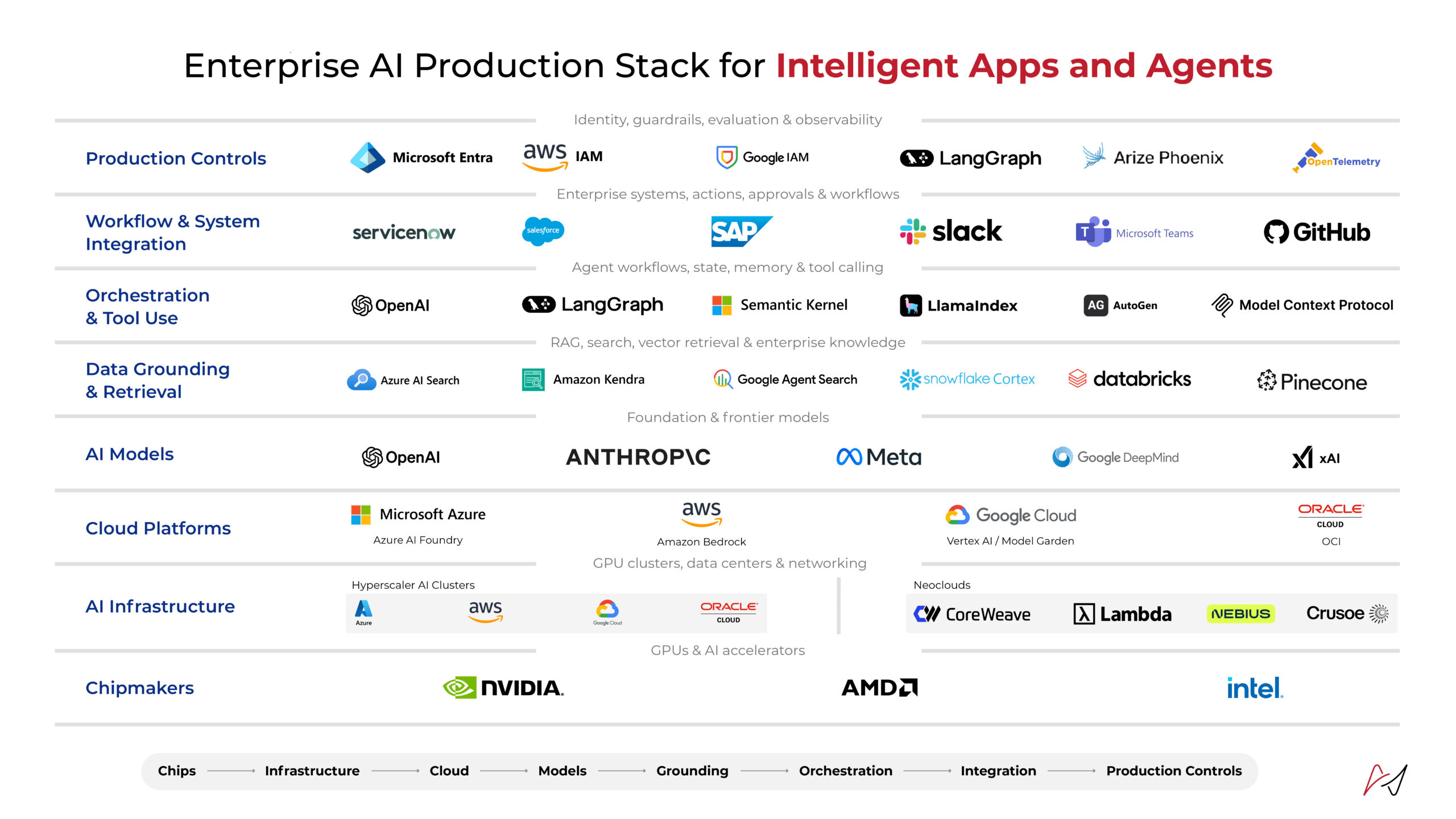
Figure 2: Enterprise AI Production Stack
The Enterprise AI Production Stack gives builders a practical way to move from tool selection to production readiness.
How to read the Enterprise AI Production Stack
The Enterprise AI Production Stack shows how builders move from AI capability to trusted production. The lower layers represent where most enterprises already start: chips, AI infrastructure, cloud platforms, and models. Teams are often already committed to a cloud, a data platform, a model provider, or a GPU strategy. They are not starting from a blank page.
The upper layers show what turns model access into enterprise value. Data grounding gives agents the right business context. Orchestration and tool use help agents plan, call tools, manage state, and connect steps. Workflow and system integration connect AI to the systems where work gets done. Production controls help teams govern actions, evaluate quality, observe behavior, manage risk, and keep humans in control where judgment matters.
For example, an Azure-first enterprise might already have Azure as the hyperscaler, Azure databases for operational data, Databricks for lakehouse and analytics data, and Azure OpenAI for model access. That starting point matters. The team does not need to begin by asking which agent framework is most popular. They should begin by asking how their existing cloud, identity, data, and model lanes help them get to trusted production.
From there, the production questions become clearer. What enterprise data should ground the agent? Which tools and workflows should it touch? Which actions need approval? How will quality be evaluated? How will behavior be observed? Who owns the system after launch?
That is why the stack matters. It moves the conversation from “Which framework should we use?” to “Which stack gets us to trusted production?”
Seven decisions that move AI to production
Trusted production comes from seven decisions.
- First, choose the model lane.
Choose models based on workload needs, quality, cost, latency, data sensitivity, context needs, and risk. Some workloads need frontier models. Some workloads need open models. Some workloads need managed model access through the enterprise cloud or data platform.
The point is not model loyalty. The point is model fit.
- Second, ground AI in enterprise data.
Intelligent apps and agents need business context. That means trusted data, search, documents, databases, APIs, and knowledge sources.
Grounding is where many systems either earn trust or lose it. If the agent does not know the right context, the output will not matter.
- Third, govern tool use.
Agents should not get broad freedom by default. Define what they read, suggest, change, approve, escalate, and log.
Tool use is where enterprise AI moves from answer generation to business action. That is why governance matters.
- Fourth, evaluate quality.
Evaluation should not wait until the end. Teams need to test answer quality, retrieval quality, tool-call success, safety, latency, cost, and task completion.
A demo shows what might work. Evaluation shows what holds up.
- Fifth, observe behavior.
Production AI needs visibility. Teams need traces, logs, metrics, feedback, cost visibility, and failure analysis.
If teams do not see what the agent did, they do not have a production system. They have hope.
- Sixth, keep humans in control.
Some work should be automated. Some work should be reviewed. Some work should stay human-owned.
The point is not full autonomy everywhere. The point is trusted autonomy where the business supports it.
- Seventh, operate it like a business system.
Production means more than launch. It means deployment paths, security reviews, cost controls, incident response, versioning, support, and ownership.
If nobody owns the system after launch, it is not production-ready.
Ask the Production Question First
Before you pick the next agent framework, ask one question: Will this choice help us get to trusted production?
If the answer is unclear, step back. Look at the full production stack. Check the model lane, data grounding, governed tool use, evaluation, observability, human control, and production ownership.
The goal is not to use the most popular framework. The goal is to build intelligent apps and agents your enterprise trusts, operates, and scales.
Failure: AI tools everywhere, trusted production nowhere
If enterprises choose tools based on hype, AI stays fragmented. Teams build impressive demos. Frameworks multiply. Agents call tools without enough control. Data access gets messy. Governance arrives late. Costs rise without clear value. Evaluation stays thin. Observability stays weak. Humans lose visibility. Business leaders lose confidence.
Builders get blamed for problems the framework was never meant to solve.
AI tools everywhere, trusted production nowhere is the failure state to avoid.
Success: trusted AI in real operations
If enterprises choose what gets them to trusted production, AI becomes part of how the business works. Frameworks become building blocks. Models are chosen with intent. Data stays grounded. Actions stay governed. Quality gets measured. Systems are observed. Humans stay in control. Costs are managed. Production ownership is clear. Business leaders see value.
That is the success state: AI becomes trusted operating reality.
Closing
Agent frameworks matter. They help teams build workflows, manage state, call tools, and connect steps. But they are not the strategy.
Do not choose the most popular framework. Choose what gets you to trusted production. The real decision is not which framework looks strongest today. The real decision is which stack gets your enterprise to trusted production.
Frameworks help you build. Production stacks help you trust. Trusted AI is the goal.
Do not choose the most popular framework. Choose what gets you to trusted production.
The real decision is not which framework looks strongest today. The real decision is which stack gets your enterprise to trusted production.
Frameworks help you build. Production stacks help you trust. Trusted AI is the goal.
References
- Microsoft Foundry Agent Service
- Azure AI Search for retrieval-augmented generation
- Microsoft Entra
- OpenAI: Building agents
- Amazon Bedrock Agents
- Amazon Q Business
- Google Gemini Enterprise Agent Platform
- Snowflake Cortex Agents
- Model Context Protocol
- LangGraph overview
- LangSmith docs
- CoreWeave: The Essential Cloud for AI
Categories > Leadership/AI
Tags > Artificial Intelligence, Technology, AI Agents, Enterprise AI, AI Governance, AI Strategy, Agentic AI, AI Platforms, AI Tools, Production AI, Enterprise Architecture